
Get your latest forecast information directly from Canada's official weather source: canada.ca/WeatherCAN. Setup custom AQHI notifications to receive alerts.
Current air quality
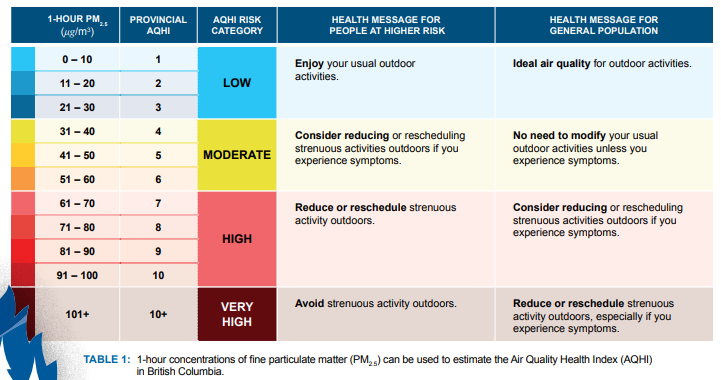
The current Air Quality Health Index (AQHI) in the Central Okanagan identifies the health risk associated with local air quality conditions. The index corresponds to the recommendations (below) for outdoor activities for those at risk and the general population.
People with heart or lung conditions, the elderly, children, and pregnant women are considered more sensitive to air pollution. Follow your doctor’s usual advice about exercising and managing your condition.
Additional resources
Sign-up for email and text notifications for Air Quality Warnings.
Other resources from the province:
Air Quality or Smoky Skies Warnings
- Check the Province of BC's Air Quality Health Index frequently as conditions can change within hours. If you are planning a trip within BC, check conditions in your destination area before and during your trip and learn how to protect your health.
- Smoke concentrations will vary widely as winds, fire behaviour and temperatures change.
- Check the BC Wildfires Map and smoke forecasts to look for active wildfires and how smoke could affect our region in the next 48 hours.
- Check the Wildfire smoke webpage from the BC Centre for Disease Control
- Check road conditions using DriveBC
What to do when smoke levels are high
The most important thing to do is reduce your exposure to smoke. Be sure to drink lots of water, which can help reduce inflammation. Try to not be too active. View the Wildfire smoke webpage from BC Centre for Disease Control for more information.
At home:
- Stay indoors as much as possible.
- Try to keep your indoor environment smoke-free.
- Keep doors, windows and fireplace dampers shut.
- Avoid smoking cigarettes, burning candles or incense, using woodstoves, and vacuuming during smoky periods (each of these causes unhealthy particulates to circulate in your indoor air).
- Consider a portable air cleaner for your home (see Portable air cleaner from BC Centre for Disease Control).
- Use air conditioners on the recirculation setting so outside air will not be moved inside.
- Don't exercise outdoors.
At the office:
- Reduce fresh air uptake into homes/offices.
- Buildings such as shopping malls, community centres and libraries also tend to have better indoor air quality because they have larger air filtration systems.
Face masks:
- Please check the BC Centre for Disease Control guideline on Face masks during wildfires.
Older adults and children:
- Take extra precaution with children, who are more susceptible to smoke because their breathing systems are still developing and they breathe in more air (and therefore more smoke) than adults.
- Older adults are more likely to have heart or lung disease, which can make them more susceptible to smoke. Extra precaution should also be taken during forest fire season.
While driving:
- Keep your windows and vents closed while driving.
- Only use air conditioning in the “recirculate” setting.
- Check road conditions on DriveBC.
- If you are responsible for children or organizing an outdoor event (such as coaches, teachers, daycares, and sports clubs) be aware that smoke conditions may change within hours.
- Check the Central Okanagan Current Air Quality Conditions and Smoke Forecasts to make an informed decision.
- Planned events during the wildfire season will not necessarily be cancelled due to high AQHI readings. Organizers may decide to cancel events when the AQHI indicates “high” to “very high” health risks.
- Organizers may provide alternatives to outdoor events, such as moving an event indoors, altering the duration, or postponing until the smoke has cleared.
- The AQHI can be used as a tool to make personal decisions for your activities and decide whether to attend outdoor events when the sky is smoky. More information on cancelling or modifying outdoor events during the wildfire season can be found here:
Although we can't get rid of the smoke outdoors, there are a number of options for creating cleaner air at home.
DIY air cleaners
See the BC Lung Foundation's page on DIY air cleaners for step-by-step guides and instructional videos on how to build your own air cleaner unit for less than $100.
Install a HEPA air filtration unit
HEPA air filtration units, also known as air purifiers, are portable appliances that filter out tiny particulate matter (PM) - 2.5 microns and smaller. These ultrafine particles are the most common and dangerous component of wildfire smoke. HEPA air filtration units typically come with replaceable carbon pre-filters that also remove the Volatile Organic Compounds in wildfire smoke, such as benzene, acrolein, and formaldehyde. Pre-filters take care of larger particles such as pollen too. The units blow out filtered air, so they can double as fans too!
HEPA air filters work best when all windows and outside doors are closed. Buy the right air filtration unit to fit the room where you'll use it most frequently, such as the bedroom. Most units list the size of room they can filter effectively. Others list a Clean Air Delivery Rate (CADR), in which case, choose a tobacco smoke CADR that covers at least two thirds of the room's area. If you buy a portable air cleaner, follow the manufacturer's specifications to choose the right size for the room you will use it in.
Central heating or cooling
The filters that can provide effective protection from wildfire smoke are the MERV 13 up to HEPA. Be sure to have filter replacements available. During prolonged smoke events the filter's efficiency could be affected.
Small low-cost air quality PM sensor pilot project (2021-2023)
The Regional District of Central Okanagan in collaboration with local governments, Interior Health and some local residents, is participating on a Small Low-Cost Air Quality PM Sensor Pilot Project. This is a three-year pilot conducted by the Meteorological Services of Canada (MSC), a branch within Environment and Climate Change Canada (ECCC), to investigate the benefit of using emerging low-cost sensor technologies to measure Particulate Matter (PM) and to partner with governments, institutions and interested stakeholders to augment current air quality (AQ) monitoring networks.
Low-cost PM sensor locations
ECCC provided ten low-cost Air Quality Particulate Matter Sensors to the Central Okanagan. These sensors are located at:
- Fire Station 101 - North Westside
- Fire Station 51 - Joe Rich
- Peachland Municipal Hall
- North Kelowna
- East Kelowna
- Glenmore
- Lower Mission
- West Kelowna (2)
- Rutland
Map
Real-time PM2.5 data is available on this project's air quality map or this Purple Air map.
The Purple Air sensor data displayed on the UNBC map includes a correction factor to improve the data accuracy.
This map displays data in western Canada and bordering regions, such as Alaska and Washington, data from both the regulatory grade monitors and the Purple Air sensors, the ECCC Firework PM2.5 forecast, NRCan active fire locations and fire danger ratings, satellite data as well as other meteorological parameters of interest.
The goal of this project is not to replace the existing network but to expand into areas that do not have existing monitoring or sufficient spatial coverage with existing monitoring.
National Air Quality Pollution Surveillance (NAPS) site vs. Low-cost PM sensors:
NAPS - Since 1994, Kelowna has hosted one provincial monitoring station “Kelowna KLO Road - Air monitoring station.” This station is located at the RDCO KLO Road property and is part of the NAPS network. NAPS sites provide the observations that are used to generate the Air Quality Health Index (AQHI) and forecasting products (air quality advisories, smoke bulletins, etc.). The RDCO also uses this monitoring station data (PM2.5 (24hr) to provide current outdoor burning conditions through the RDCO outdoor burning system. The provincial station measures many other pollutants: H2S Hydrogen sulfide, PM2.5, PM10, sulphur dioxide (SO2), nitrogen oxides (NOX), ozone (O3), and carbon monoxide (CO).The low-cost sensor project is focused on PM2.5 alone.
Private owners
If you are planning to buy or already have a PurpleAir sensor and would like your sensor to be shown in the project's map, please be sure to register your sensor visibility as “public (everyone).”
For more information and Q&A on the low-cost sensors project, please check the air quality collaborator information sheet.
- Province of BC - Be prepared for wildfire smoke
- Interior Health -2024 Extreme heat and wildfire preparation for local governments
- Statistical Summaries of main pollutants- Kelowna monitoring station
Contact Us
Regional air quality coordinator
Send an email to regional air quality coordinator
Phone: 250-469-8408


