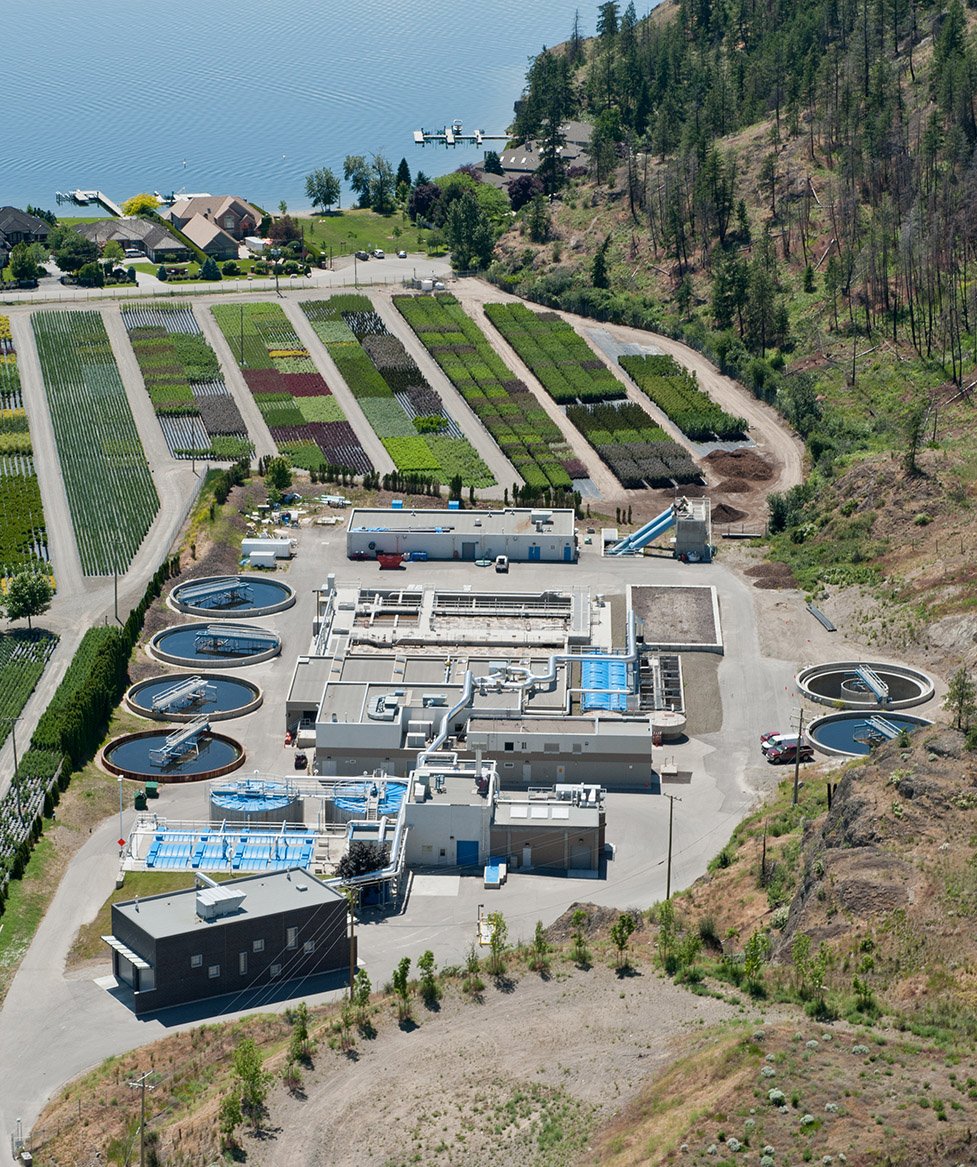
Westside regional wastewater treatment plant

The Westside Regional Wastewater Treatment Plant is located on Gellatly Road in West Kelowna and receives wastewater from the City of West Kelowna, the District of Peachland and Westbank First Nation IR #9 and #10.

How the wastewater treatment plant works

The water treatment plant provides wastewater treatment for approximately 42,000 people. The plant capacity is 16.8 m3/day with a current average day flow is 11 m3/day. Wastewater enters the facility, goes through 3-stages of treatment before being pumped back into Okanagan Lake.

The Westbank Process

Did you know? Our wastewater treatment plant process is an internationally recognized method of treating wastewater.

Wastewater enters the plant through a Parshall flume (to provide control and monitoring of flow) and is then screened and degritted prior to receiving primary clarification. The plant operates a secondary treatment process called the “Westbank Process,” an internationally recognized process of treating wastewater. The Westbank Process is based on the 3-Stage Bardenpho process with provisions for a Return Activated Sludge denitrification upstream of the anaerobic zone. Each bioreactor feeds a dedicated secondary clarifier. The effluent undergoes tertiary treatment via filtration and Ultra Violet disinfection. The tertiary treated effluent from the plant is discharged into Okanagan Lake through an outfall.

The primary solids stream at the treatment plant undergoes fermentation, while the waste secondary solids stream is treated with a DAF thickener. Both streams are pumped to a centrifuge for dewatering with the dewatered sludge trucked off site for disposal.

Development Cost Charges (DCC's) are the primary funding source for growth-related infrastructure capacity upgrades.

The Regional District currently collects DCC's for the Westside Regional Wastewater Treatment Plant DCC | Bylaw No. 1448 and East Trunk Development Cost Charges | Bylaw No. 1463.

The Wastewater Treatment Plant DCC is being collected from new development projects that receive wastewater treatment service from the regional facility in the City of West Kelowna, District of Peachland and Westbank First Nation. Funds collected assist the Regional District with the capital costs of future development-driven expansion at the RDCO facility.

The East Trunk DCC is being collected from new development projects that receive wastewater collection service through the East Trunk in the City of West Kelowna and Westbank First Nation. Funds collected assist the Regional District with the capital costs of development driven expansion in the RDCO collection system.

According to the Ministry of Housing and Municipal Affairs, a major DCC bylaw review is recommended every five years. The Westside Wastewater Service Standing Committee endorsed the Westside Wastewater DCC – major review on November 6, 2025. The first round of engagement was a letter to  affected parties sent by December 2025. The DCC Major Review and associated draft bylaws will be presented to the RDCO Board in early 2026 for first reading, followed by a second round of broader public engagement.

What you put down the drain at home or work can ultimately affect the quality of our Okanagan Lake drinking water source. This is why stopping pollutants at the source is so important. By not putting certain items down the drain, we help protect our wastewater treatment infrastructure.

Source control is:

  • Pollution prevention
  • Environmental protection
  • A key step to the success of wastewater treatment

What not to flush

Biosolids is a nutrient-dense organic material made from treated sewage sludge. They are a beneficial resource containing essential plant nutrients.

There are two processing facilities, one in Spallumcheen and one in Princeton. These facilities manage the biosolids generated from the Westside Regional Wastewater Treatment facility for composting and final land application.

The Province of BC is reviewing information and regulations related to biosolids, land application and the Organic Matter Recycling Regulation and related requirements.

Collection System Report

Okanagan Lake Collaborative Agreement

Westside Regional Wastewater Treatment Plant

Westside Regional Wastewater Treatment Plant Odour Assessment